How to Tell an Original Painting From a Print

You've found a painting you love, maybe in a gallery, maybe on a screen late at night, and a small question rises: is this the real thing? Knowing how to tell if a painting is original is less mysterious than it sounds. By the end of this post you'll know what to look for and what to feel for, from raised paint and the marks of a brush or knife to the edges, the back of the canvas and the pattern a print gives away under magnification. You'll also know where a hand-embellished giclee print fits, because it sits honestly between the two.
Start With the Light: Raised Paint and Shadow
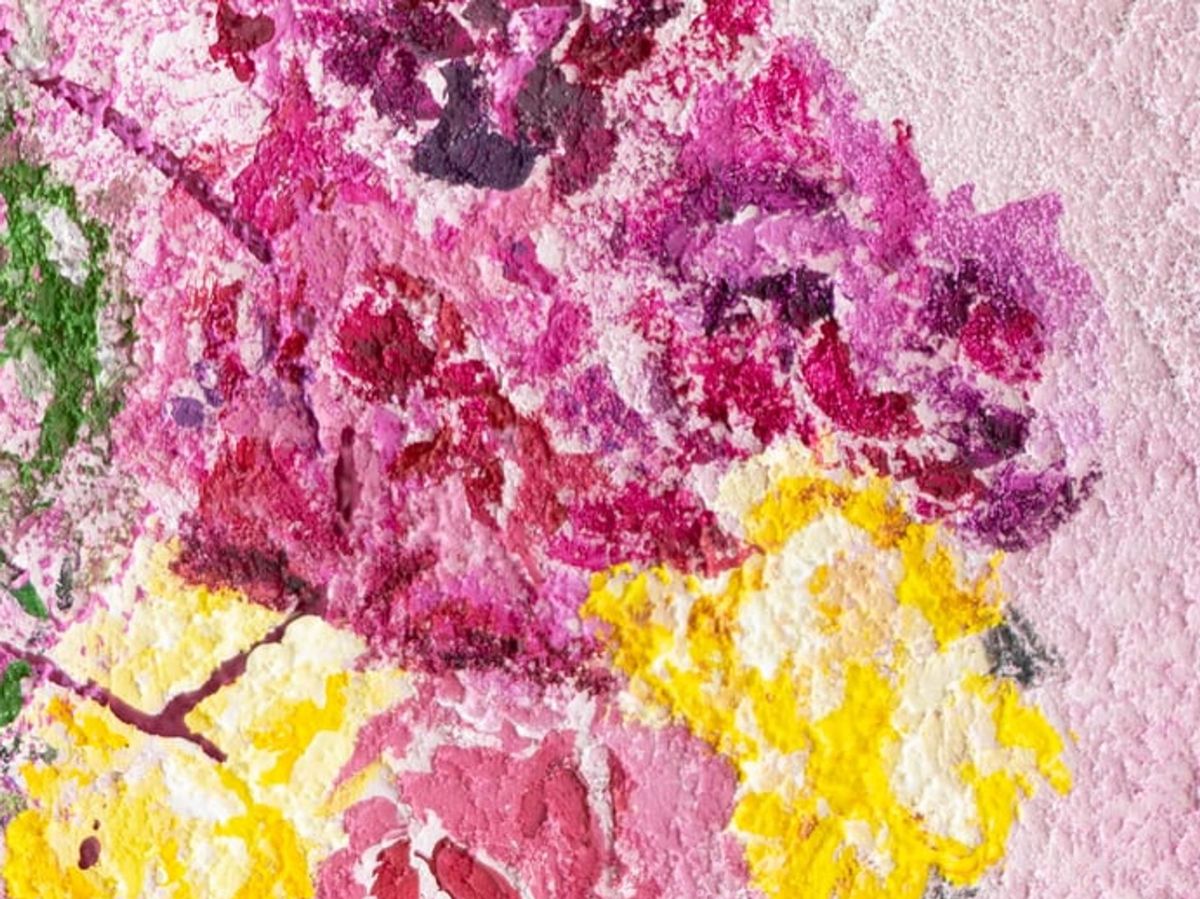
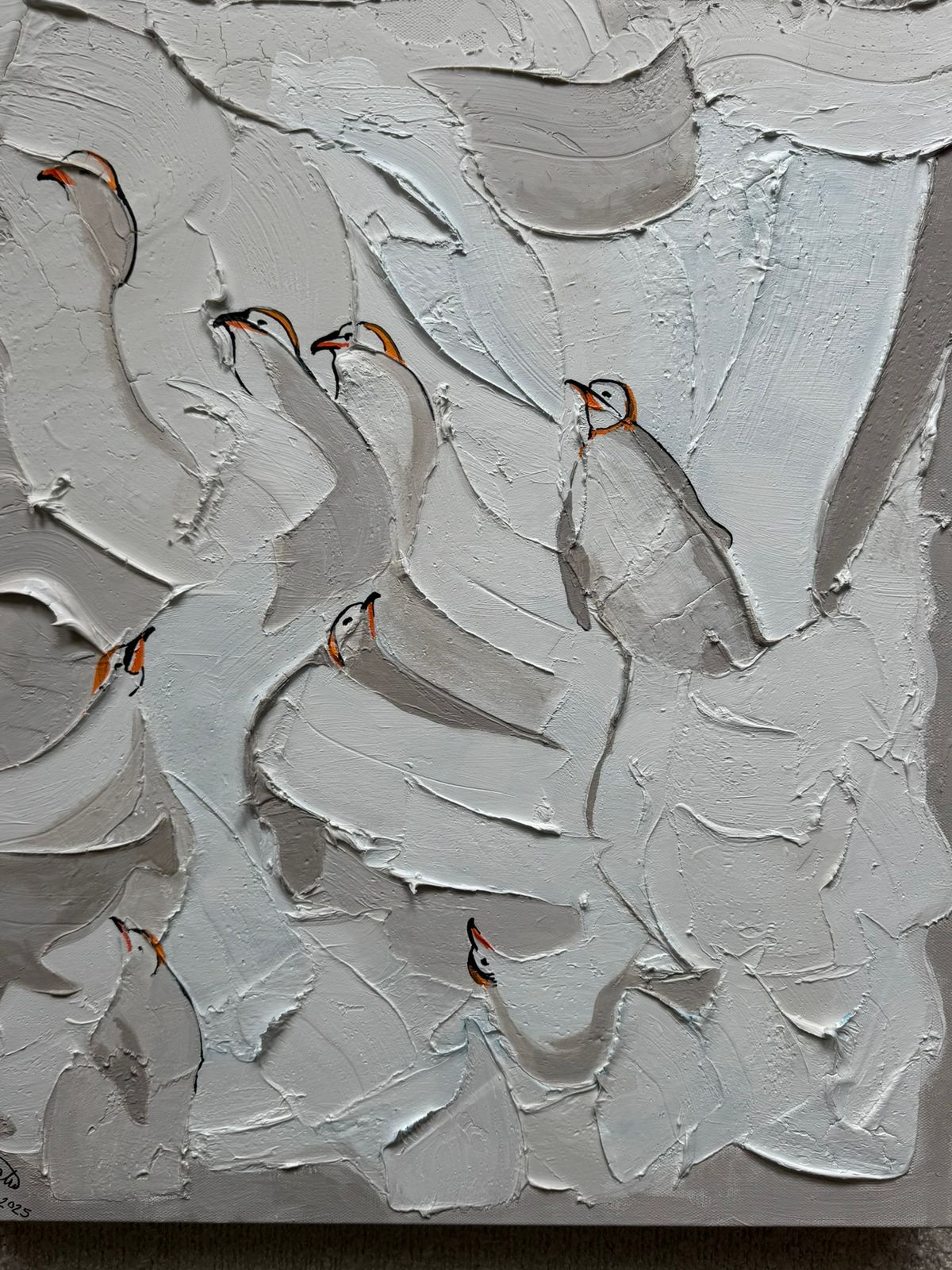
The simplest test is also the most beautiful one. Stand to the side of the painting, or hold a small flashlight almost flat against the surface, and let the light skim across it. Paint that was applied by hand has a body. Even thin paint often leaves slight ridges where a stroke began and ended, and thick paint rises into peaks and valleys that catch the light on one side and throw tiny shadows on the other.
A print, even a very good one on canvas, is flat. What looks like texture is a photograph of texture. Move your head and the highlights don't move with you, because they are printed into the image.
There are a few things that can fool you at first glance:
- Canvas weave. Prints on canvas show the fabric's grain, but that texture is even and repeats across the whole surface, regardless of what the image is doing.
- Added clear strokes. Some prints have a clear gel brushed over them to imitate brushwork. Look closely: do the ridges follow the image? In a real painting, the color travels up the side of a ridge and changes where the stroke changes. Clear strokes on a print often wander across color boundaries, and the color underneath stays perfectly flat.
- Embossed texture. Pressed texture tends to look slightly soft and uniform, without the crisp edges of a real stroke.
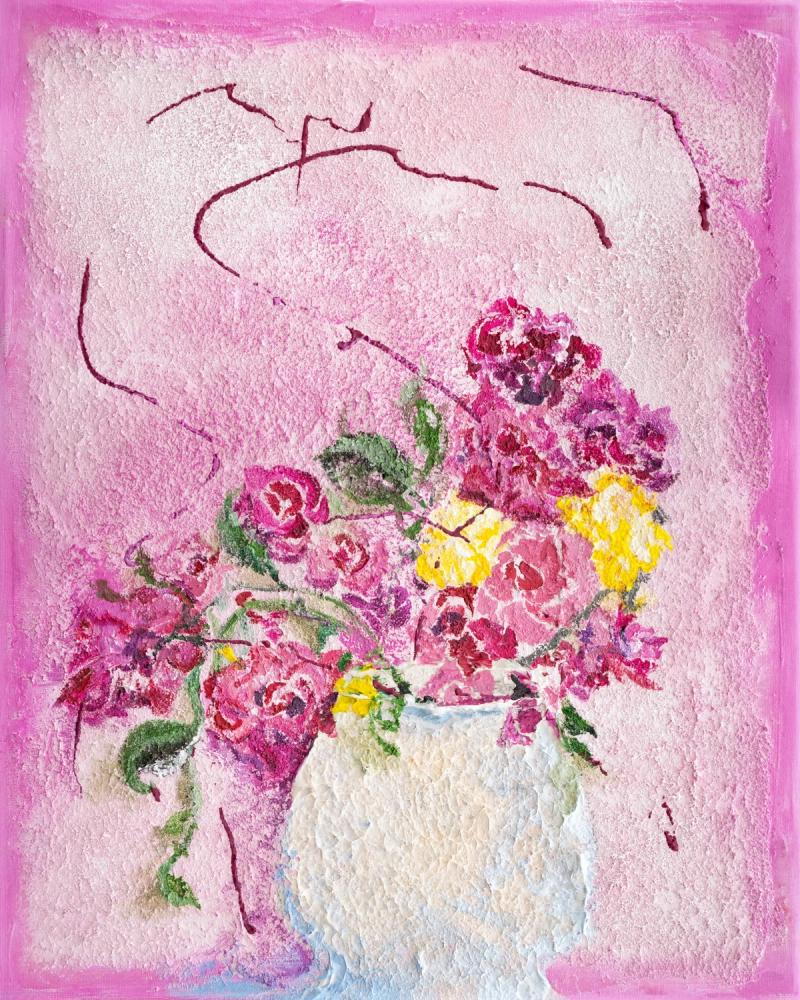
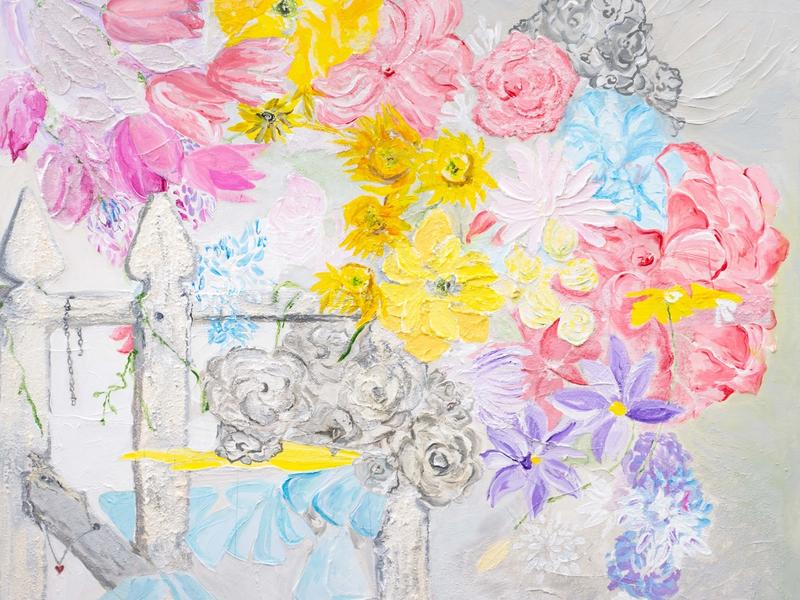
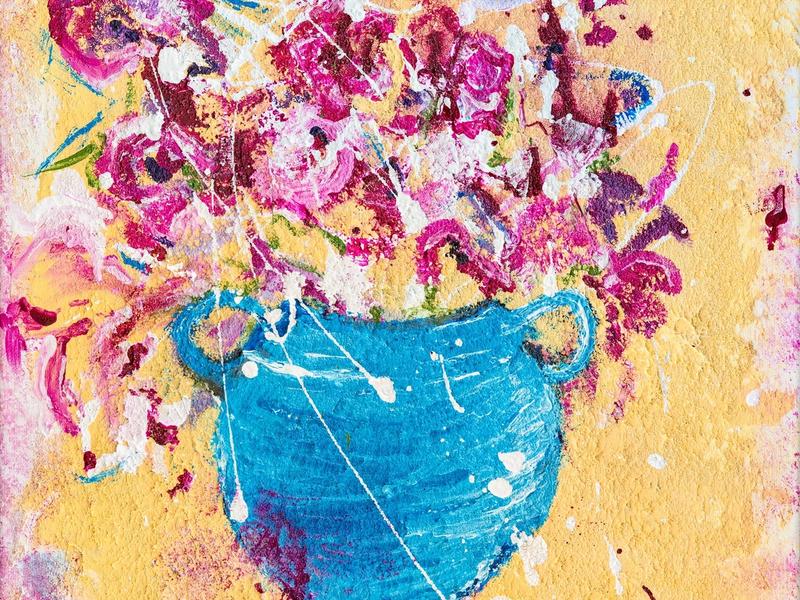
This is where my own work lives. I paint with heavy-body acrylic, thick enough to stand up off the canvas, applied with palette knives and brushes. In A Vase Full of Dreams, every petal is built up so the bouquet seems to lift right off the canvas. As the light changes through the day, those raised surfaces create subtle shadows, and the painting looks a little different from every angle. That shifting is something no flat reproduction can hold.
Brush and Knife Marks Show How the Paint Arrived
Once you've seen the surface in raking light, look at the individual marks. A painting is a record of movement, and each tool leaves its own handwriting.
A brush leaves fine parallel grooves from the bristles. A stroke often starts heavy, where the brush was loaded, and thins out as the paint runs low. Sometimes a single stray bristle drags a hairline through the paint.
A palette knife leaves smooth, flat planes with crisp edges, and paint often gathers into a little lip at the end of a stroke where the knife lifted away. When two colors are dragged together with a knife, they streak and partly blend instead of mixing evenly.
You'll also see layers. Earlier colors peek through gaps in later ones, and paint sits on top of paint. In a print, all of that is part of the picture, but none of it is part of the surface.
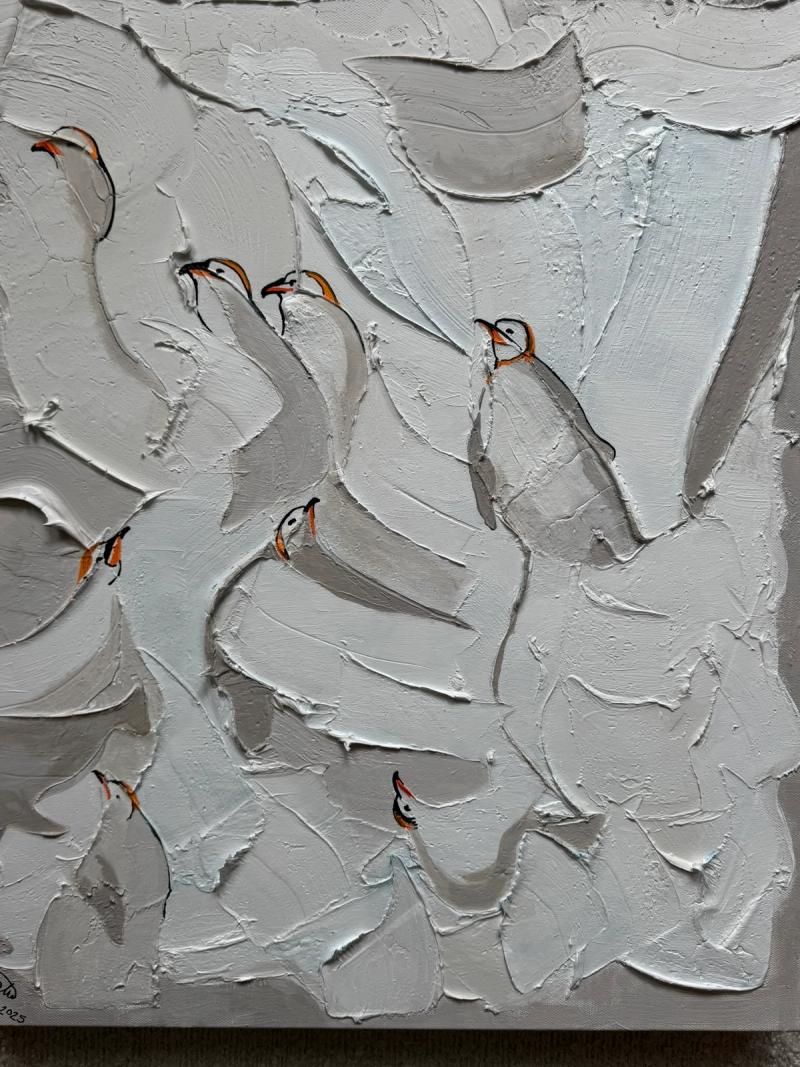
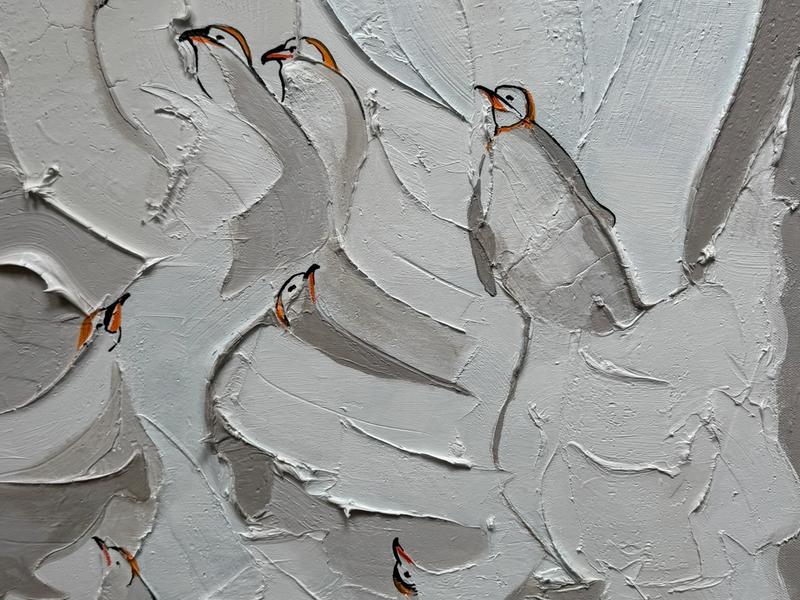
Preparing for Flight is a good example of how much a surface can carry. It uses rich, sculpted layers of monochromatic paint, and a gathering of penguins is carved directly into that tactile surface, gazing upward. In a painting that is nearly all one color, the light and shadow moving across the carved paint do much of the work. You understand it by looking at it from more than one place in the room.
Check the Edges
The sides of a canvas are honest. On an original, paint often wraps around the edge or stops in an irregular way. You may find brush marks continuing around the corner, a drip, or a line where tape once was. On a gallery-wrapped canvas, the painting may simply carry on around the sides.
Prints on canvas usually handle edges in one of a few tidy ways: a solid color, a mirrored strip of the image, or the image itself stretched around the sides. The color tends to stop at a clean, mechanical line, and the edge is as flat as the front.
If a piece is framed, a floater frame lets you see the edges through the gap between canvas and frame. Behind glass, it's harder, and that is when the next two tests matter most.
Turn It Over: What the Back of the Canvas Tells You
The back of a painting can say a lot. Look for the stretcher bars and how the canvas is fastened, any handwriting such as a title, date or signature, and labels from galleries or exhibitions. Stray paint on the stretcher or the folded canvas at the corners is a common sign of hands at work.
Prints often carry a printer's or publisher's label, an edition number, or a certificate. A certificate on its own isn't proof of anything, so read it alongside everything else you've noticed.
Signatures deserve a second look, too. I sign my work JASTRU, and a signature made in paint sits on the surface with its own slight relief. A printed signature is part of the image and lies perfectly flat.
Notice the Sheen
Paint doesn't reflect light evenly. Thick strokes, thin washes and different colors can each have a slightly different gloss, so when you tilt an original, parts of it shine while others stay quiet. A print usually has one even sheen across the whole surface, the sheen of its paper, canvas or coating.
A caution: a final varnish can even out the sheen of a painting, so this test works best as one clue among several, not as a verdict.
The Loupe Test: How to Tell If a Painting Is Original Up Close
If you're serious about collecting, a small jeweler's loupe (around 10x) is worth carrying. Choose a flat area of the image and look closely.
- Offset printed posters show a regular pattern of tiny dots in cyan, magenta, yellow and black, often arranged in little rosettes.
- Inkjet and giclee prints show a fine, scattered mist of dots, a little like spray, with no paint body at all.
- Paint shows continuous color: pigment, the grain of a stroke, edges where one color overlaps another. No dots.
This is often the clearest test of all, especially for pieces behind glass or with a varnish that hides the sheen.
A print shows you a picture of texture. A painting has texture that casts its own shadow.
Reading Online Photos of Original Artwork
Much of the art people fall for today is found online first, so it helps to know what a photo can and can't tell you. Look for:
- Angled shots, taken with light coming from the side, where ridges and shadows show up.
- Close-up details of the surface, where you can see stroke edges and layers.
- The edges and the back, if they're shown.
- The description. Words like "acrylic on canvas" or "heavy-body acrylic impasto" describe a painting. Words like "print," "reproduction," "giclee," "canvas print" or an edition number describe a print.
If something isn't clear, ask the seller. A good one will be glad you did.
Where Hand-Embellished Giclee Prints Fit
There is a third kind of piece, and it deserves an honest description: a print with real paint on top. A hand-embellished giclee begins as a high-quality reproduction of an original painting. The artist then applies paint and texture by hand to select areas.
Under your loupe, a hand-embellished print shows both worlds: the fine dots of the print in the flat areas, and real raised paint where the artist worked into it. It is not an original painting, and it shouldn't be described as one. It also isn't a plain print. Clear wording matters, so you always know what you're bringing home.
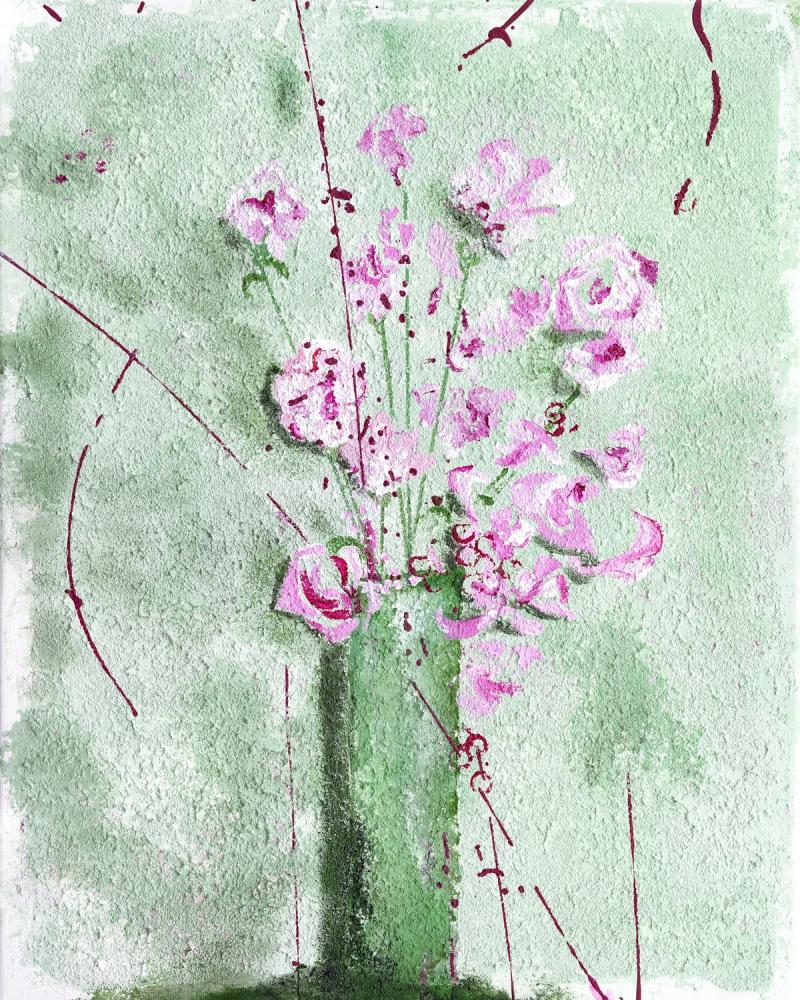
This is how I make mine. I start with an archival giclee reproduction of one of my paintings, then I personally apply paint and texture to select areas, giving the print added dimension and character. Because that work is done by hand, there are subtle differences in texture, movement and detail from one print to another, and no two are exactly alike. Take The Gentle Things, with its soft pink blossoms rising from a slender green vase against a hazy sage ground. The original is a one-of-a-kind painting. A hand-embellished print of it carries the same image, finished by my hand, so it brings some of the dimensional quality of the canvas into the reproduction. If you'd like to weigh the choices side by side, I wrote more in Original Painting, Giclee Print or Hand-Embellished Print?
Come Closer
I believe art should be felt as much as seen, and every test above is really a way of looking more closely, which is the best part of loving a painting anyway. If one of my pieces has caught your eye and you'd like to know more about it, whether it's an original or a hand-embellished print, I'd love to hear from you through the contact page. And if what you're imagining doesn't exist yet, we can talk about a commission. Every one begins with a conversation.